10 hr
Full-Day Abu Simbel Excursion from Aswan
- Expert local guide
- Small group
- Skip-the-line access
- Free cancellation
Abu Simbel Tour From Aswan — Reserved Entry to the Ramses II Temples
Four colossi hold the desert dawn, two temples wait beyond.
Compare fares, pick the fit — all bookings are mobile-voucher and eligible for free cancellation where shown.
10 hr
10 hr
10 hr
Worth it for nearly every first-time visitor
An abu simbel tour from aswan asks for two commitments: the 750 EGP entrance fee and the long haul south to the Sudanese border. For that money you get the colossal seated figures of Ramses II carved into a mountainside, plus the smaller Hathor temple next door, both rescued and relocated block by block. No other Nubian monument delivers this scale of rock-cut craftsmanship. The added transport cost and predawn start are the real price, not the ticket, which is modest against what you see. These Aswan landmarks pay off for anyone drawn to ancient engineering, photography, or Ramesside grandeur. Well-organised abu simbel tour from aswan tours bundle the logistics so you skip the planning headache. It pays off less for travellers already templed-out, on tight budgets counting every pound, or unwilling to lose most of a day in transit. For a first-timer, the value math clearly favours going.
Bottom line: If it is your first trip south, the abu simbel tour from aswan tickets earn their keep several times over.
Most visitors booking an abu simbel tour from aswan settle this with budget: the road convoy costs a fraction of the price, while the EgyptAir hop buys back an entire day.
|
Top pick Road Convoy |
EgyptAir Flight | |
|---|---|---|
| How you get there | Air-conditioned bus or minibus in a group convoy | Short EgyptAir domestic hop, Aswan to Abu Simbel airport |
| Travel time each way | 3–4 hours on desert highway | About 45–50 minutes in the air |
| Approximate cost | Roughly $8–$30 per person (shared bus) | Roughly $75–$150 one-way, taxes included |
| Comfort and safety record | Long desert drive, security checkpoints en route | Established EgyptAir route, no road fatigue |
| Flexibility of schedule | Fixed convoy departures, mainly pre-dawn | Multiple daily flights, easier to rebook |
| Best for | Budget travelers with a free day to spare | Cruise passengers and short-stay visitors |
| See tickets & prices |
Verdict: Choose the road convoy to save money on your abu simbel tour from aswan tickets if you can handle a pre-dawn start, and choose the flight if your itinerary or budget favors speed over savings.
Hand-picked experiences loved by thousands of travelers
9 hours
Free Cancellation
Discover the architectural wonders of the Ramses II and Nefertari temples on this exclusive private day tour from Aswan.
10 hours
Free Cancellation
Experience Egypt’s grandeur at Abu Simbel and the vibrant culture of a traditional Nubian village on this private day trip.
15 hours
Free Cancellation
Discover the colossal wonders of Abu Simbel with a private, stress-free day trip including lunch and expert guidance.
Most Abu Simbel tour from Aswan departures leave before dawn to reach the site during the cooler morning window
Visitors pass through security and the main gate where the 750 EGP entrance fee is paid by card
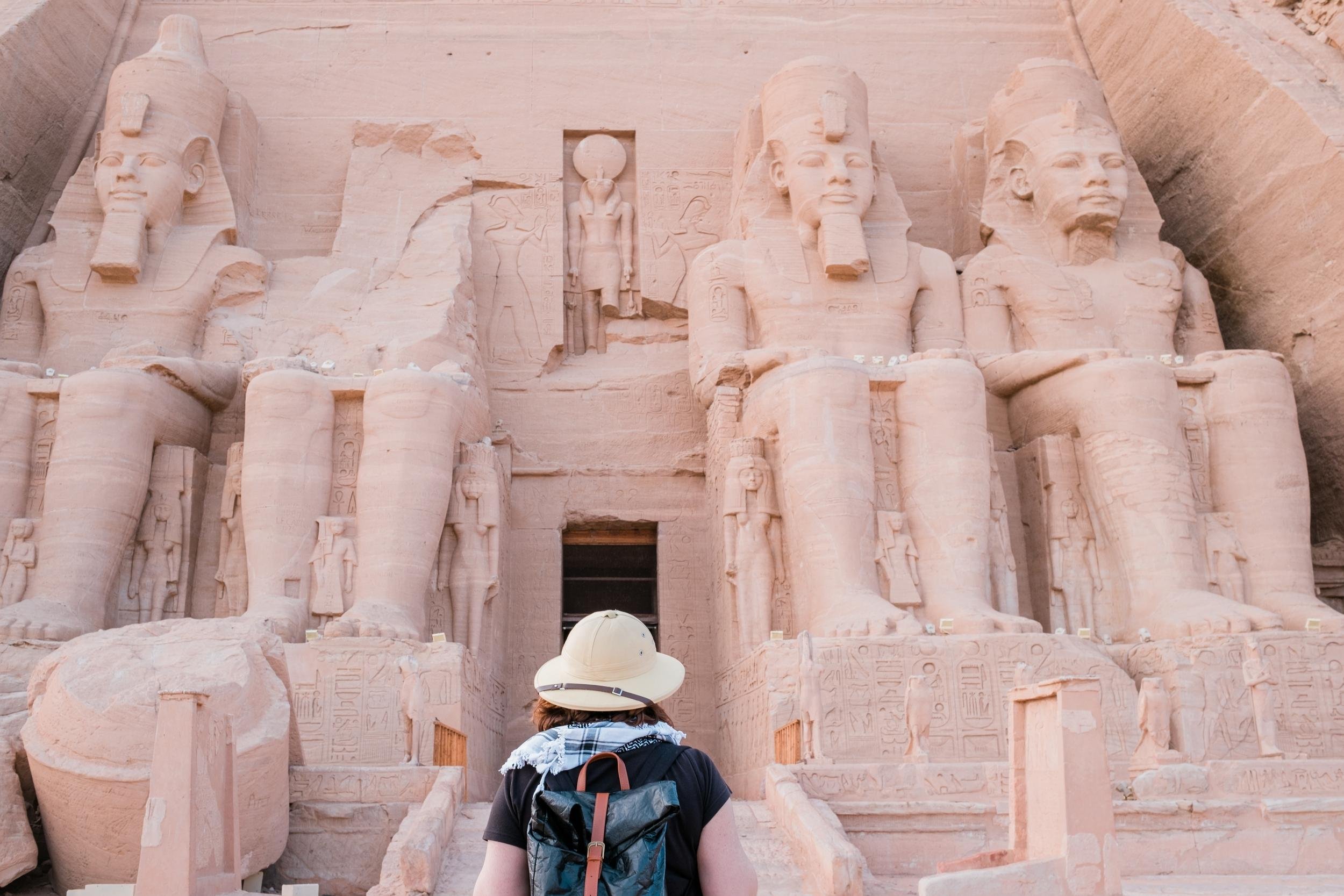
Walk past the four colossal seated statues into the hypostyle hall and inner sanctuary
Shorter visit to the temple dedicated to Nefertari and the goddess Hathor
Free time along the Lake Nasser shoreline between the two temples
Return journey by road or short flight back to Aswan
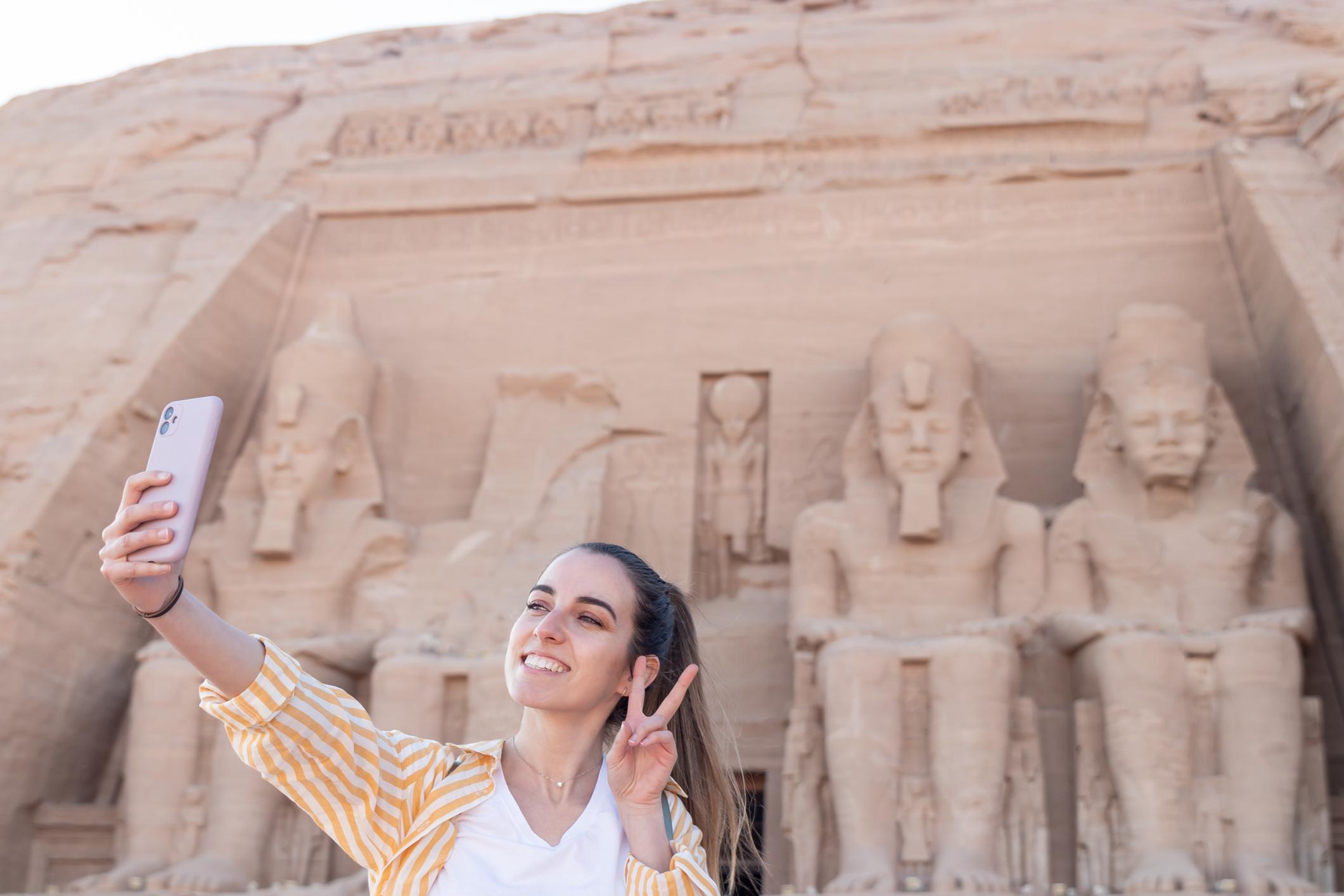
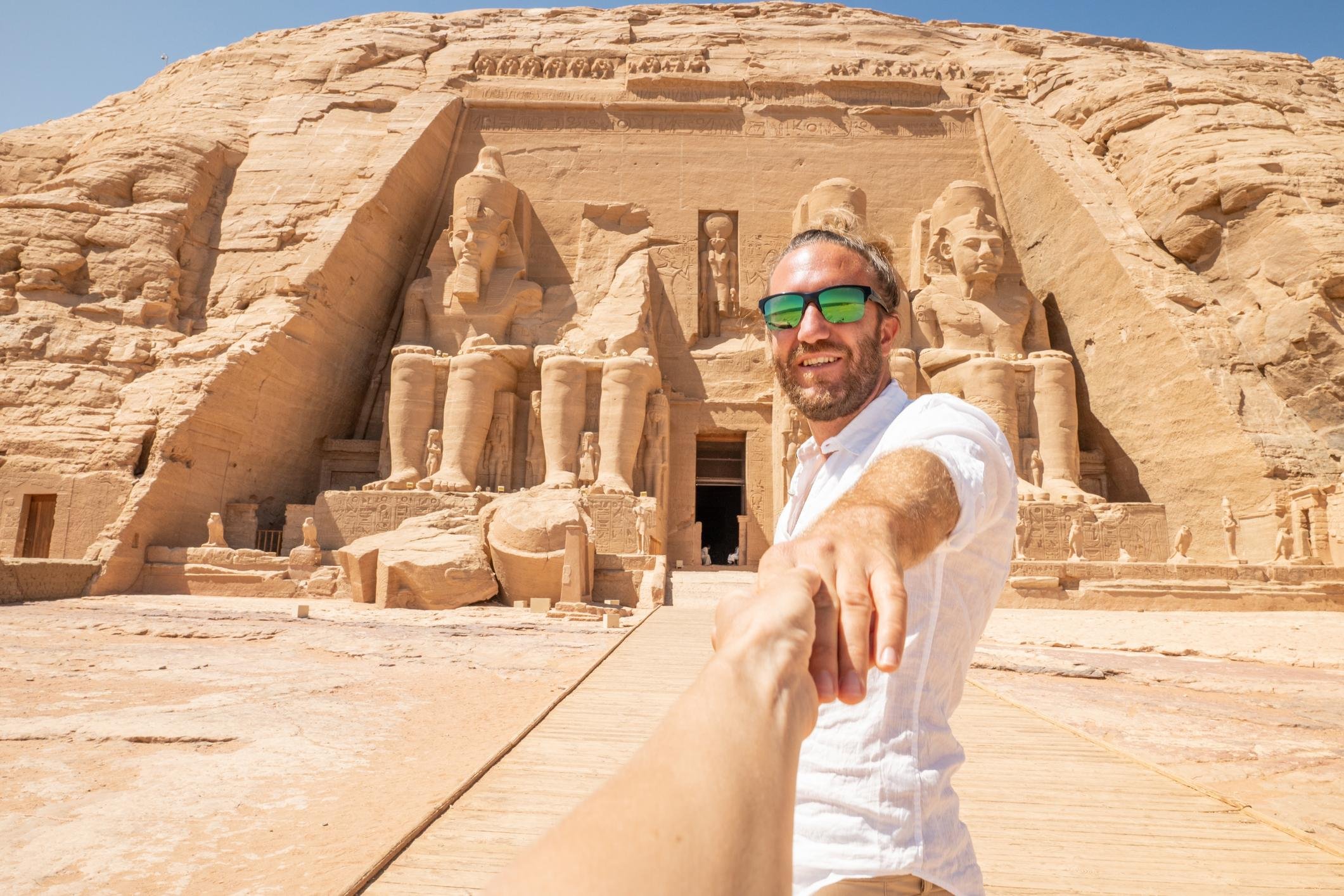
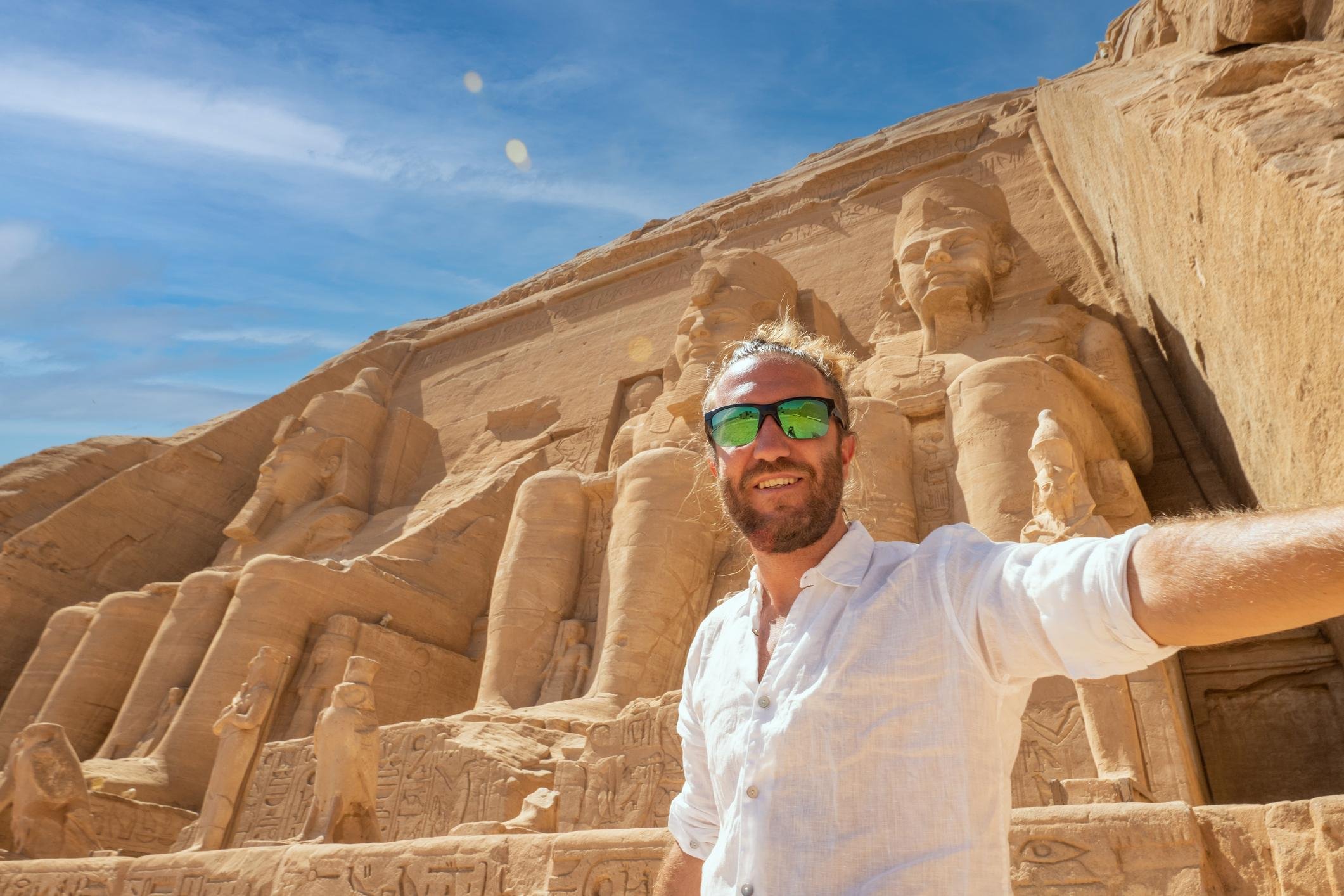
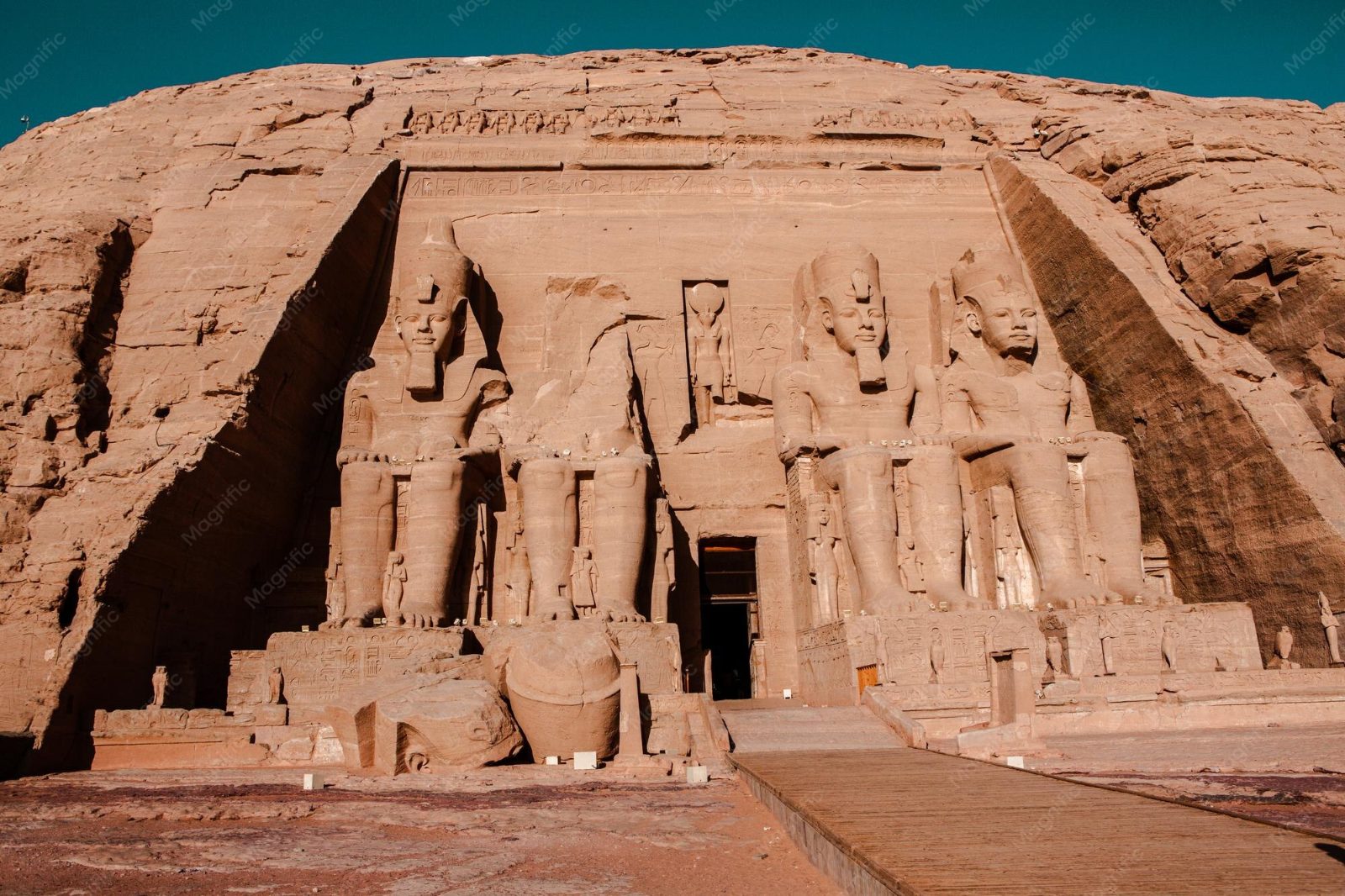
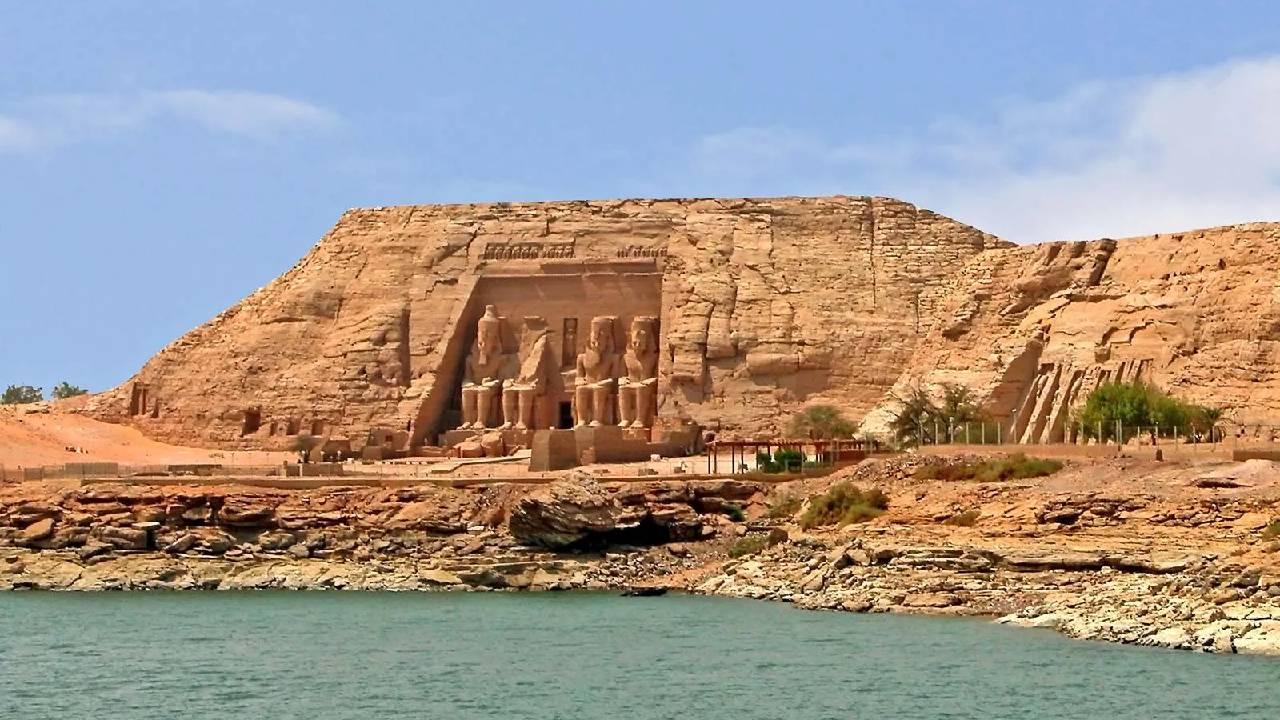
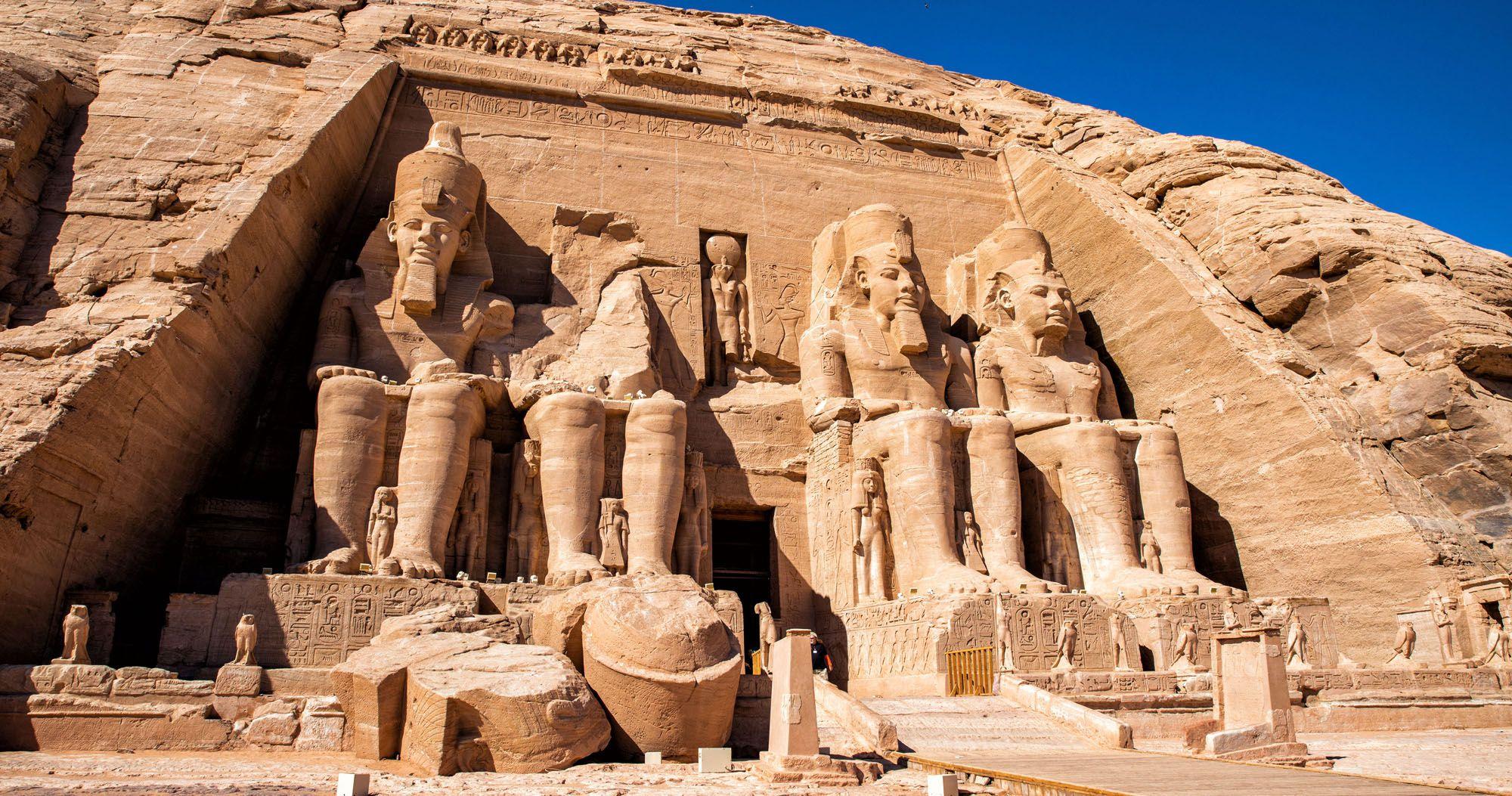
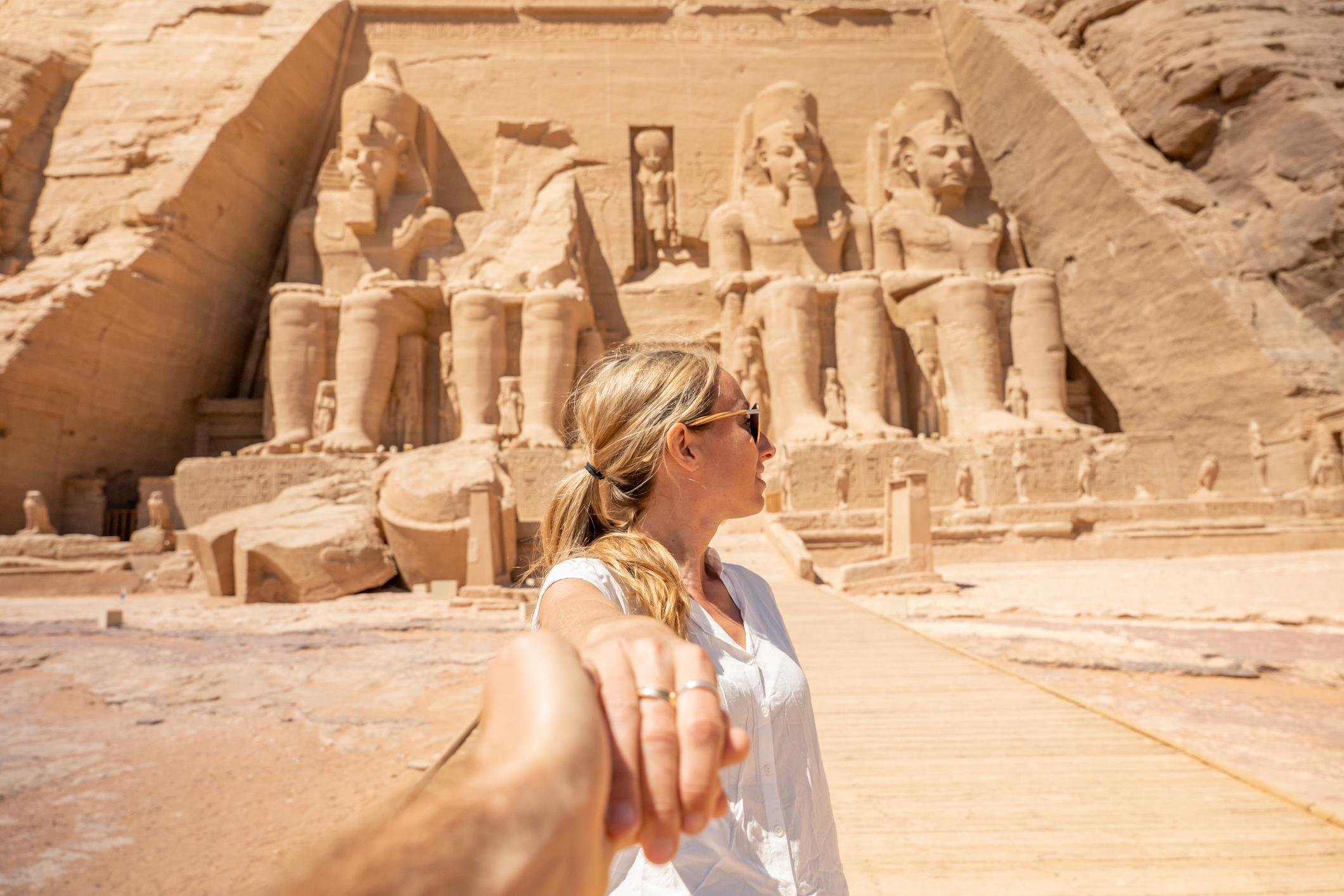
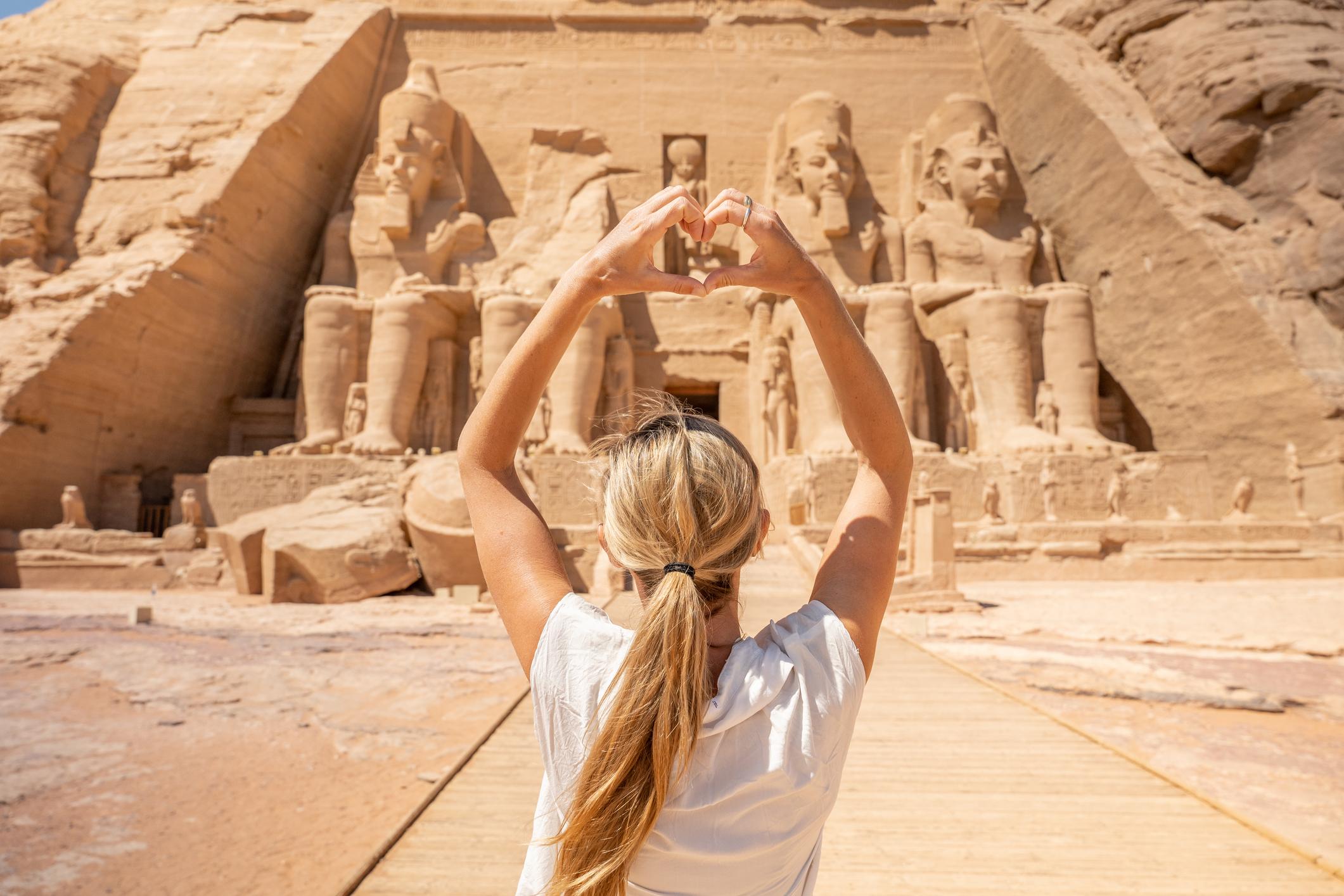
Four seated colossi of Ramesses II, each roughly 20 meters tall, flank the entrance carved directly into a sandstone cliff face. The facade and hypostyle hall inside were cut from solid rock in the 13th century BCE and later relocated in more than 1,000 blocks during the 1960s rescue.
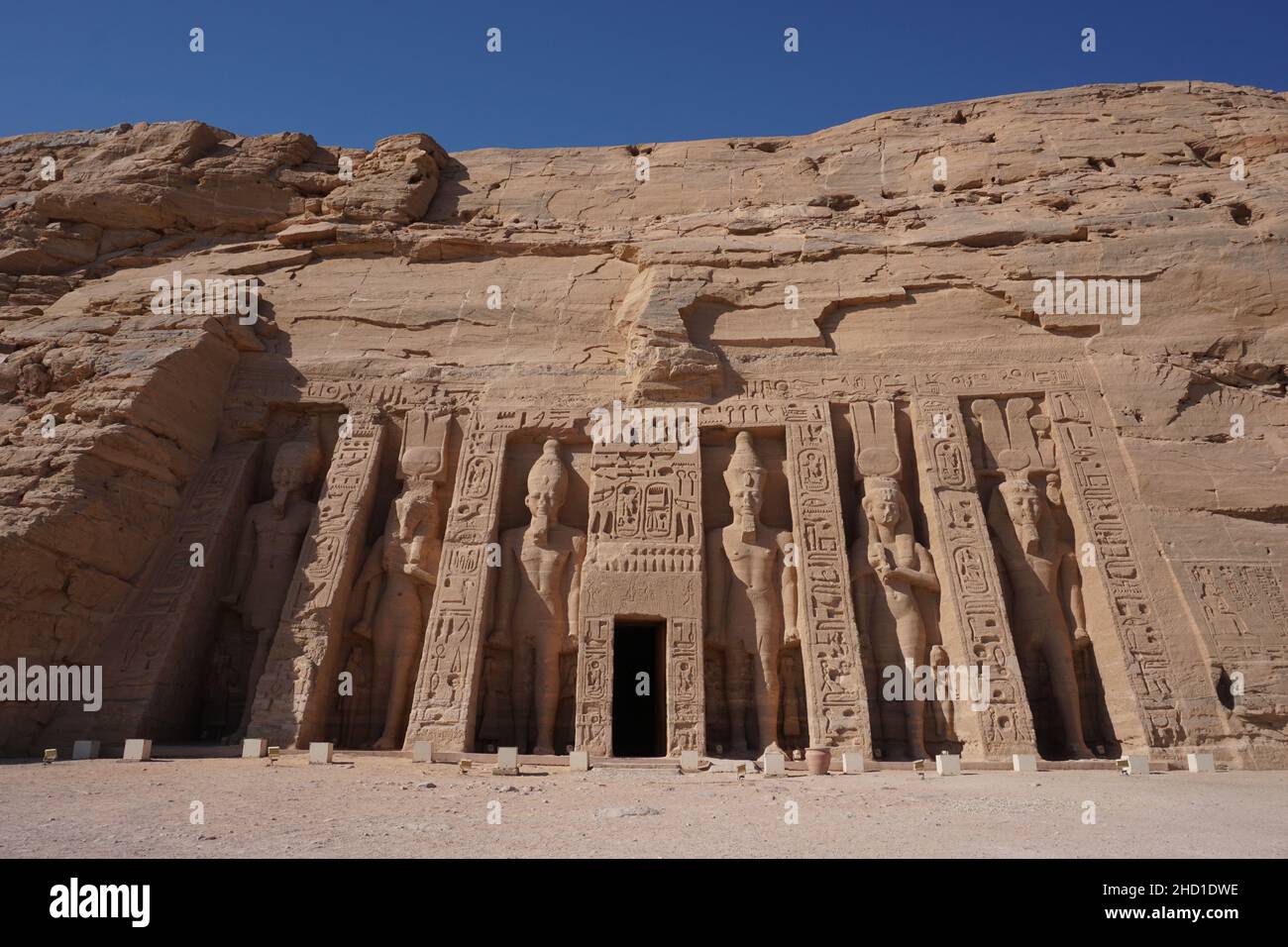
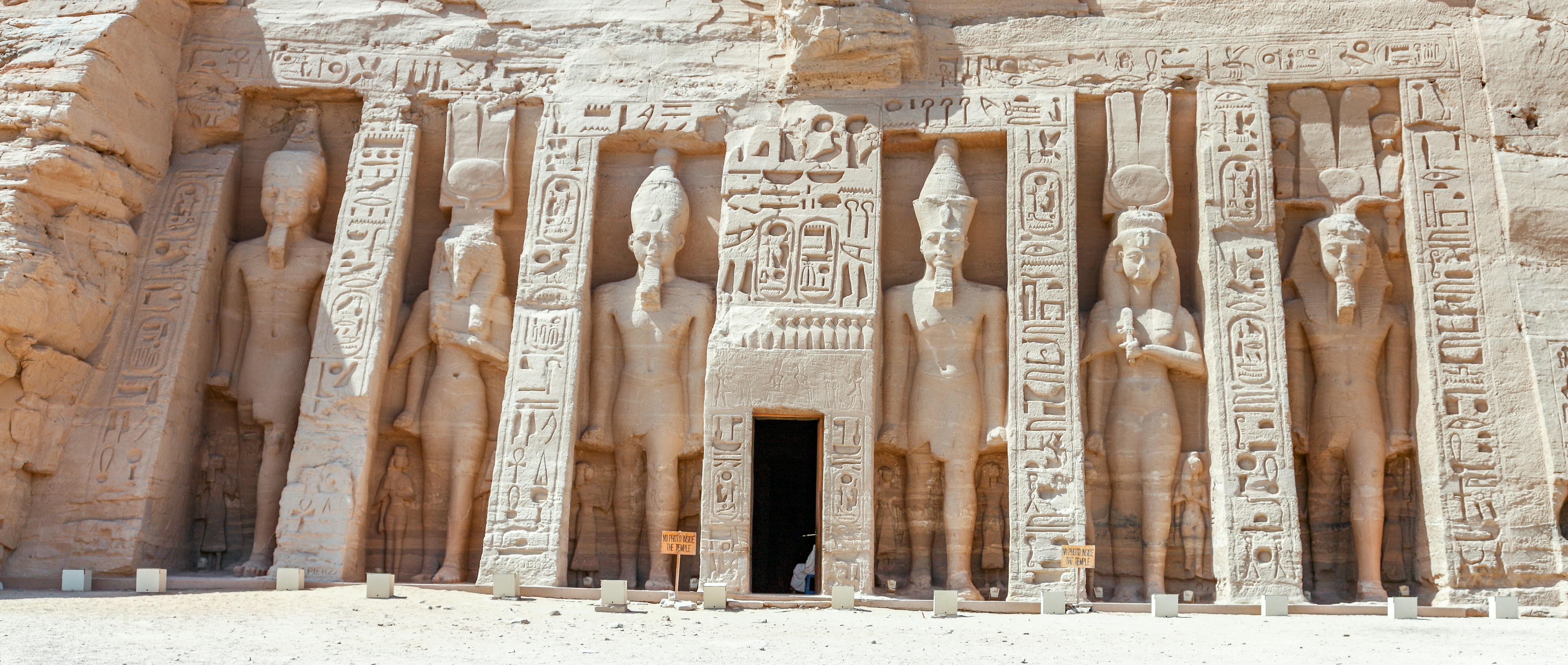
Dedicated to Queen Nefertari and the goddess Hathor, this temple is unusual because Nefertari's statues stand the same height as those of Ramesses II, a rare parity in Egyptian royal art. Six standing colossi, four of the king and two of the queen, line its facade.
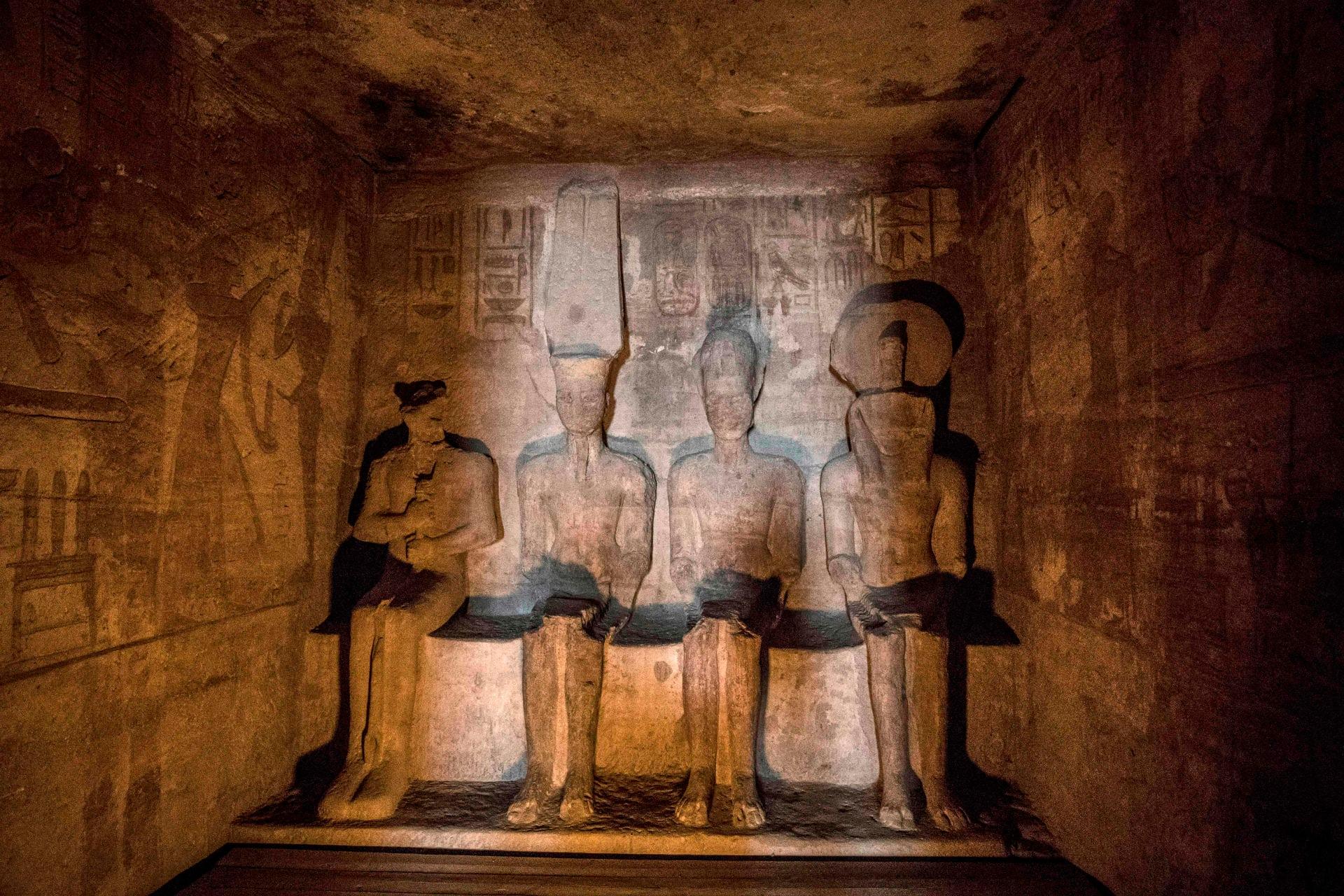
Deep inside the Great Temple sits a chamber with four seated statues of Ramesses II, Amun-Ra, Ra-Horakhty, and Ptah. Twice a year, on dates around 22 February and 22 October, sunlight travels the length of the temple to illuminate three of the four figures.
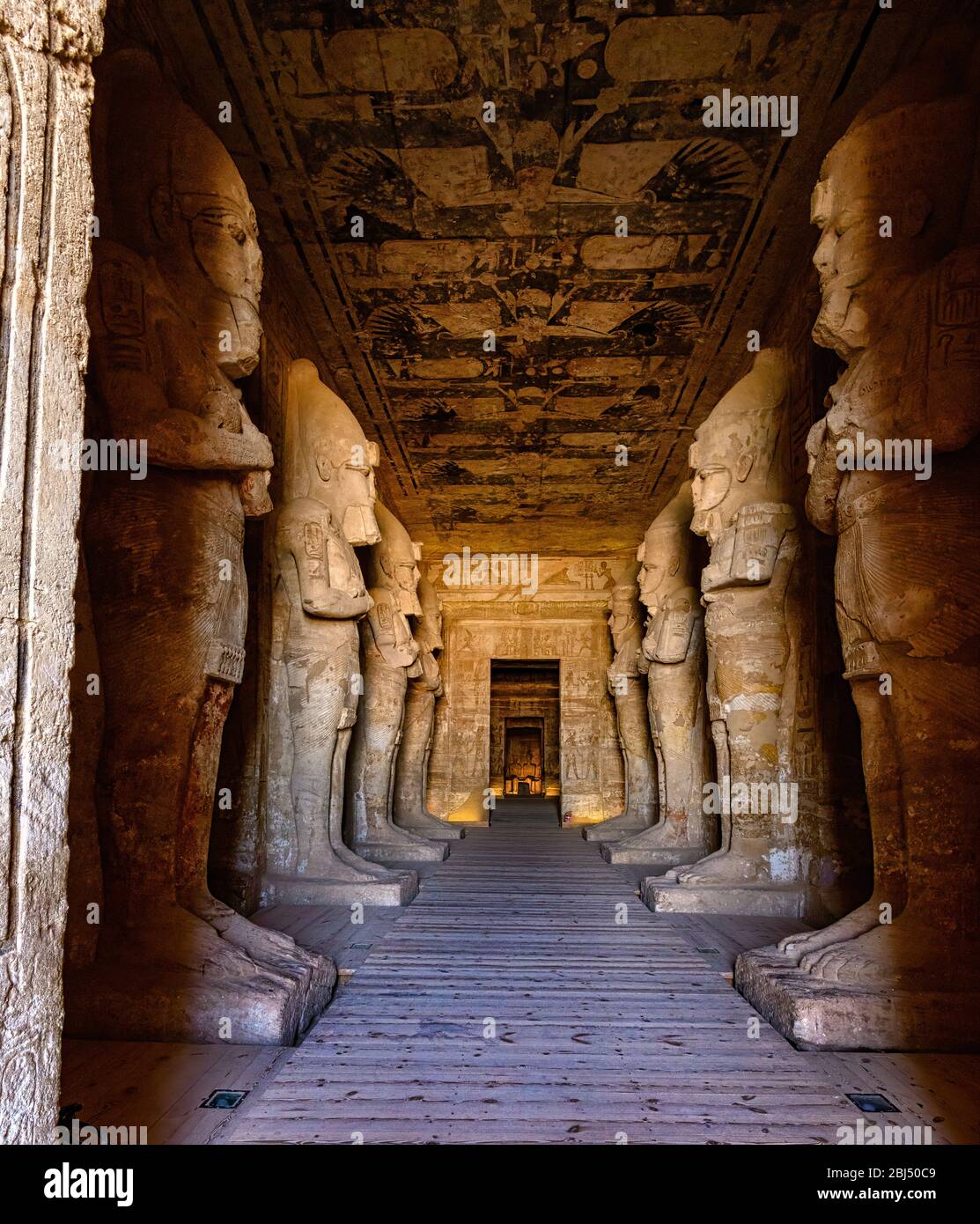
A columned hall lined with eight Osiride pillars depicting Ramesses II in the guise of the god Osiris leads toward the inner sanctuary. Wall reliefs here depict the Battle of Kadesh in extensive carved detail.
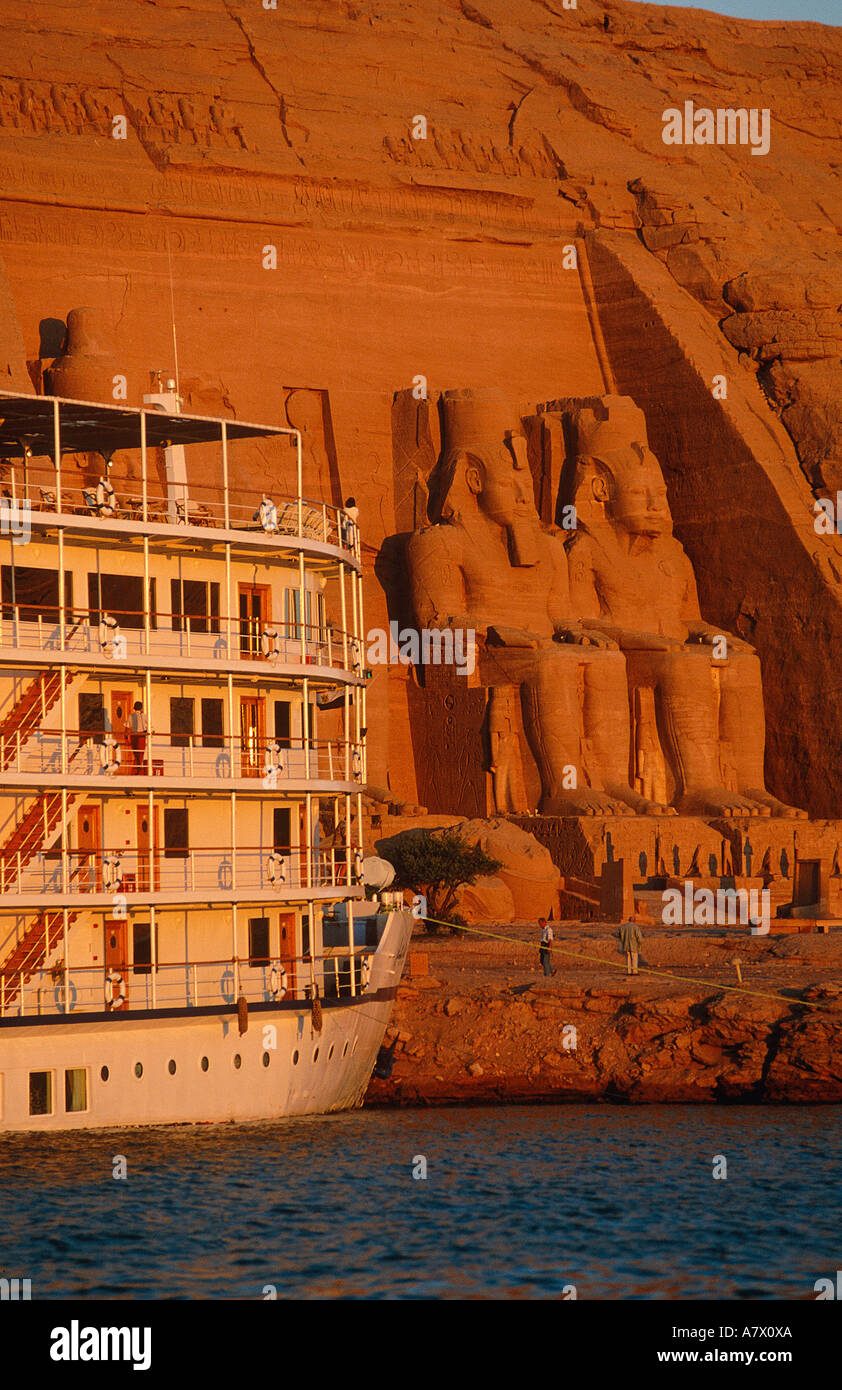
The plaza between the two temples opens directly onto the shoreline of Lake Nasser, the reservoir created by the Aswan High Dam whose rising waters prompted the temples' relocation. The open water view contrasts with the surrounding desert cliffs.
A discreet marker near the temple complex notes the original lower location of the temples before the 1960s UNESCO engineering effort raised them about 64 meters higher and moved them roughly 180 meters back from the water.
You leave Aswan in darkness, the desert road unrolling south toward Lake Nasser as the sky pales. By the time the temples appear, the light is low and gold — arrive within the 06:00–09:00 window and the sandstone is cool, the crowds still thin. You walk the curved path around the artificial hill, and the four colossi of Ramses II rise ahead of you, each face lit from the east. You pause at their feet, where smaller figures of family reach barely to the pharaoh's knees. Stepping into the Great Temple, you cross the hypostyle hall between eight Osiris pillars, tracing the Battle of Kadesh reliefs along the walls with your eyes. Deeper in, you reach the sanctuary where four seated gods wait in the dark. Outside again, you cross to Nefertari's temple, smaller, quieter, its facade carved with standing figures. Your abu simbel tour from aswan tour closes at the water's edge, Lake Nasser flat and bright, the temples behind you exactly as the engineers rebuilt them.
All the details about your upcoming adventure in one place
An abu simbel tour from aswan brings you to the twin temples that Ramesses II carved into the Nubian sandstone above Lake Nasser, guarded by four colossal seated statues at the Great Temple entrance. Guided abu simbel tour from aswan tours pair a licensed Egyptologist with comfortable transfers, so you can focus on the hieroglyphs, the sun-alignment sanctuary, and the smaller Temple of Hathor dedicated to Queen Nefertari. These UNESCO-listed monuments sit close to the Sudanese border, and a well-run temple visit makes the long desert crossing straightforward.
In 1968, an entire mountainside was cut into 1,036 numbered blocks and lifted 65 metres above the rising Nile to save two temples from drowning. That rescue defines what visitors reach today on an abu simbel tour from aswan, roughly 280 kilometres south, near the Sudanese border. The temples were carved from solid sandstone during the thirteenth century BCE, ordered by Ramses II as a monument to his own reign and to intimidate Nubia to the south. Four seated colossi of the pharaoh, each about 20 metres tall, guard the entrance of the Great Temple, their faces set toward the sunrise. Beside it stands the smaller temple dedicated to Queen Nefertari and the goddess Hathor, one of the few Egyptian monuments where a queen appears at the same scale as the king. What gives this Nubian temple site its lasting reputation is engineering, ancient and modern together. The original builders aligned the Great Temple's axis so that twice each year sunlight penetrates 60 metres of rock to illuminate the inner sanctuary statues. The UNESCO relocation, a landmark of world heritage preservation, preserved that alignment when the temples were reassembled inside two artificial domed hills. A well-planned aswan abu simbel temple tour rewards travellers who understand both feats. Inside, the hypostyle hall of the Great Temple carries eight Osiris pillars depicting Ramses, their walls covered with reliefs of the Battle of Kadesh, chariots and archers rendered in low carving that still holds sharp shadow. Hieroglyphic inscriptions record treaties, offerings, and the pharaoh's campaigns. The sandstone glows amber in early light, which is why photographers gravitate toward the colossi at dawn. Today the monuments sit within a protected zone beside Lake Nasser, the reservoir whose creation once threatened them. Booking abu simbel tour from aswan tickets connects modern travellers to a story that spans three thousand years, from Ramses II's sculptors to the international teams who dismantled and rebuilt his temples stone by numbered stone.
An entire mountainside was cut into 1,036 numbered blocks and lifted above the rising Nile to save two temples from drowning.
Modest, lightweight clothing is recommended for an Abu Simbel tour from Aswan since the site sits in open desert with almost no shade. Shoulders and knees covered are appreciated when entering the sanctuary areas of the Great Temple and the Temple of Hathor, and comfortable closed-toe shoes help on the sandy approach path.
A security checkpoint with bag scanning sits at the entrance plaza before the ticket gate, similar to other major Aswan Governorate monuments. Only small daypacks are practical to carry through the Great Temple's narrow rock-cut corridors, and larger luggage should stay in the tour vehicle or convoy bus.
Personal photography without flash is permitted throughout the Great Temple of Ramesses II and the Small Temple of Hathor. Tripods and professional video rigs require separate permission from site authorities, and flash is discouraged near the painted reliefs in the inner sanctuary.
Children are welcome on an Abu Simbel tour from Aswan, and the towering four seated colossi of Ramesses II at the entrance make an easy visual highlight for younger visitors. There is little shade and no dedicated children's facilities on site, so families should plan around the cooler 06:00–09:00 window and carry water for kids.
The approach from the car park to the Great Temple's forecourt is a flat, paved and sandy path suitable for wheelchairs with assistance, though the temple interiors have uneven rock-cut floors and raised thresholds. There is no elevator or ramp into the inner sanctuary chambers, so visitors with mobility limitations may need to view the facade and forecourt only.
Food and drink are not permitted inside the Great Temple or the Small Temple of Hathor, but bottled water may be carried through the outdoor plaza and forecourt areas. There are no cafes or kiosks inside the fenced temple precinct itself, only in the small visitor area near the car park.
Quietest weekday
Busier with regional visitors
Peak weekend crowds
Hours today
06:00 – 17:00
Address
Abu Simbel Temples, Abu Simbel, Aswan Governorate, Egypt
Accessibility
Ramps at main approach, uneven sanctuary floors
Best arrival
06:00–09:00, before midday heat
Bag policy
Small bags only, no large backpacks inside temples
Getting there
Convoy or flight from Aswan, ~280 km one way
Car · 3.5-4 hours each way · Included in most private Abu Simbel tour from Aswan packages
Private vehicles join the police-escorted convoy from Aswan along the desert highway, departing from a designated assembly point before dawn.
Public transport · 3.5-4 hours each way · Lower cost than private transfer
Shared minibuses join the same convoy system and depart from central Aswan at similar early hours.
Domestic flight · About 45 minutes each way · Higher cost, ticketed separately from ground tours
Short flights connect Aswan Airport to Abu Simbel Airport for travelers short on time.
Most Abu Simbel tour from Aswan bookings can be cancelled up to 24 hours before departure for a full refund. The 750 EGP entrance fee is paid on-site by card at the main gate and is generally non-refundable once the temple ticket has been issued.
Recommended time
1.5-2.5 hours
Most travelers spend around two hours actually inside the site, enough time to walk both the Great Temple of Ramses II and the smaller Temple of Nefertari, pause at the terrace overlooking Lake Nasser, and browse the visitor center. Add 20-30 minutes if you're traveling with a guide who explains the reliefs in detail, or shave time off if you're doing a quick photo-focused loop. Since most coaches from Aswan converge in a tight morning window, the queue at the ticket gate and entrance path is where time actually gets lost, not inside the temples themselves. Booking an abu simbel tour from aswan that departs before the main convoy helps you clear the gate before it backs up.
Crowd levels through the day
Weather · crowds · average price — dots go green to amber to red as each metric rises.
Daytime temperatures stay comfortable around 20-25°C, making this the busiest season for an Abu Simbel tour from Aswan. The 22 February Sun Festival draws significant crowds and higher-priced tickets.
Mild mornings give way to rising heat by midday, so early arrival matters more each week. Crowds are moderate outside major holidays.
Midday temperatures regularly exceed 40°C in July and August, so nearly all Abu Simbel tour from Aswan operators schedule pre-dawn departures. Crowds are the lightest of the year.
Temperatures ease back into the 25-30°C range and the 22 October Sun Festival brings a second seasonal crowd peak. This is a comfortable shoulder season for road travel.
Departures before dawn from Aswan reach Abu Simbel during the cooler 06:00-09:00 window described in the site's own guidance. This avoids both the midday heat and the largest tour bus crowds.
Egyptian pounds in small denominations are useful for the ticket gate and any vendor stalls near the car park, since card payment is only confirmed at the main entrance.
The plaza between the two temples has almost no shade structures, so a hat and sunscreen matter more here than at most other Aswan Governorate sites.
The 22 February and 22 October illumination events draw much larger crowds and a higher festival-day ticket price than a standard Abu Simbel tour from Aswan.
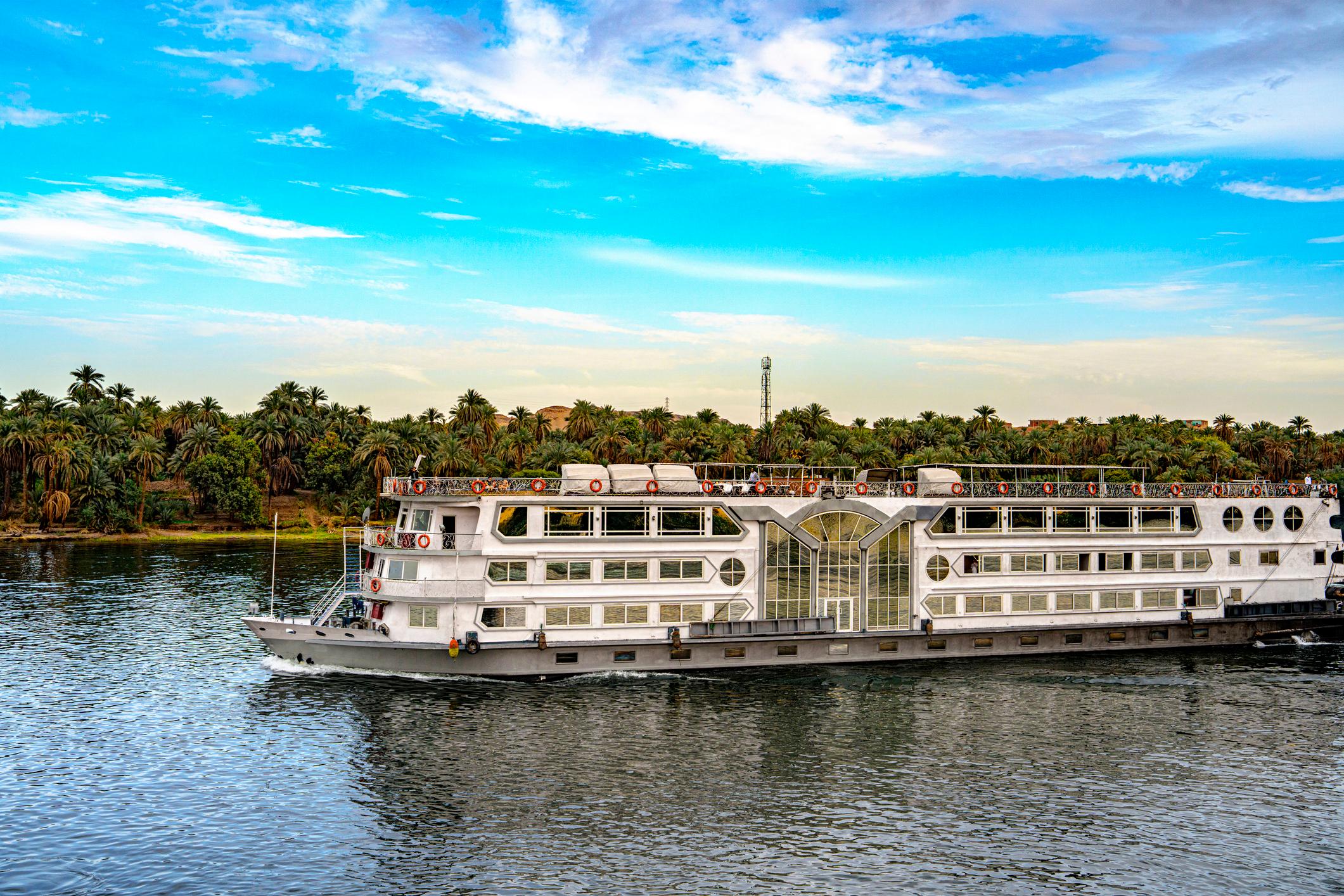
Travelers already sailing between Luxor and Aswan can often add an Abu Simbel side-trip to their existing itinerary rather than booking a separate transfer.
Road convoys to Abu Simbel run on fixed daily schedules set by local authorities, so operators confirm departure times a day in advance.
Abu Simbel Temples, Abu Simbel, Aswan Governorate, Egypt
Standard pickup point for guided Abu Simbel tour from Aswan groups
Get directionsCentral Aswan hotel district
Typical convoy departure point before dawn
Get directionsThe story behind any abu simbel tour from aswan begins around 1264 BC, when Ramesses II ordered two temples carved directly into a sandstone cliff above the Nile. The Great Temple honored the pharaoh alongside Ra-Horakhty, Amun, and Ptah. Four seated colossi, each roughly 20 meters tall, guarded its facade. The smaller temple was dedicated to Queen Nefertari and the goddess Hathor. The purpose was royal propaganda. Ramesses fixed his image at Egypt's southern frontier to impress Nubian subjects and record his account of the Battle of Kadesh, fought around 1274 BC, across the interior walls. The temples faded into desert sand for centuries. In 1813 the Swiss traveler Johann Ludwig Burckhardt spotted the buried colossi. In 1817 the Italian explorer Giovanni Belzoni cleared the entrance and reached the inner sanctuary. From then, the monument drew a slow stream of scholars and travelers, and today's descriptive abu simbel temple tour traces that same route into the rock-cut halls. The third act was a rescue. In the 1960s the Aswan High Dam threatened to drown the site beneath the rising waters of Lake Nasser. From 1964 to 1968 a UNESCO-led campaign cut both temples into more than 1,000 numbered blocks, some weighing up to 30 tons, and reassembled them 65 meters higher and 200 meters back from the original cliff. Engineers rebuilt the surrounding hills as artificial domes. The relocation cost roughly 40 million US dollars and drew specialists from across the world. This engineering feat is why an abu simbel tour from aswan reaches an intact monument rather than a submerged ruin, and it helped shape the modern UNESCO World Heritage framework, granted in 1979. Visitors comparing aswan landmarks find few with a survival story this dramatic. One detail survived the move. Twice each year, around February 22 and October 22, sunlight still penetrates the inner sanctuary to illuminate the seated gods, though the alignment shifted by one day after relocation. Those booking abu simbel tour from aswan tours today walk through 3,200 years of ambition, loss, and reconstruction. The layered history is what gives the abu simbel tour from aswan tour its weight, and travelers reserving abu simbel tour from aswan tickets encounter a monument twice built.
Ramesses II began carving the two temples into a Nubian sandstone cliff.
Construction concluded after about twenty years, dedicating temples to the gods and Nefertari.
Johann Ludwig Burckhardt sighted the sand-buried colossi of the Great Temple.
Giovanni Belzoni cleared the entrance and entered the inner sanctuary.
UNESCO engineers cut the temples into blocks and rebuilt them 65 meters higher.
The relocated temples reopened above the new shoreline of Lake Nasser.
Abu Simbel was inscribed as part of a UNESCO World Heritage Site.
Stand directly opposite the four seated colossi of Ramesses II for the classic straight-on shot with all facade details in one frame. This is the anchor image for most abu simbel tour from aswan itineraries and the spot everyone lines up for first. Space is tight near the entrance path, so arrive early to shoot before groups fill the sightline.
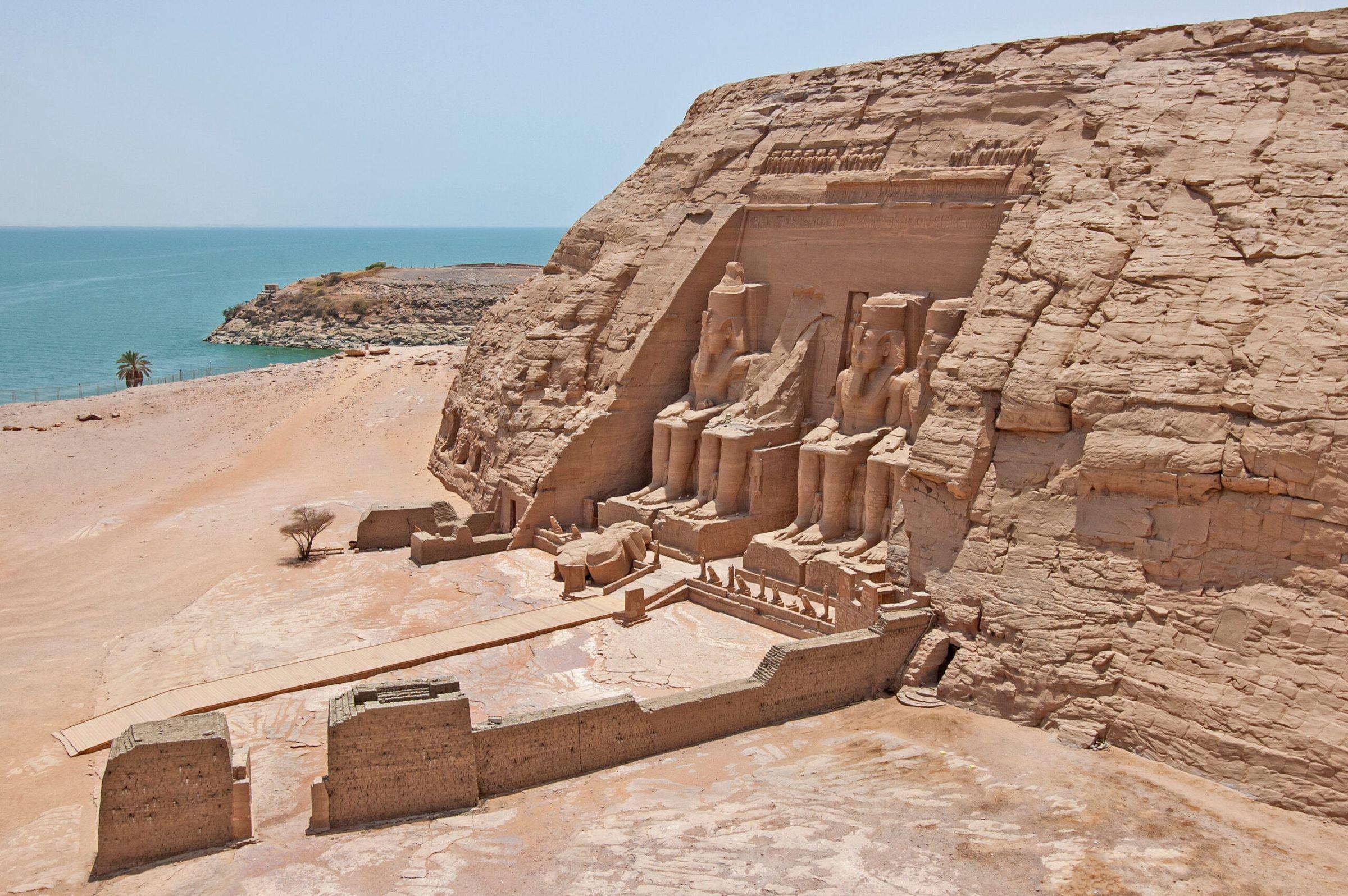
The gravel path curving in from the visitor center gives a raking angle on the colossi and the cliff face behind them, showing scale and the reconstructed dome above. It also frames Lake Nasser in the background if you stand slightly off-center. Good for wide shots without crowds in the foreground.
The six rock-cut colossi of Ramesses II and Nefertari as Hathor sit closer to the walkway, letting you fill the frame without a long lens. Shoot from the low platform directly in front for a symmetrical composition. Fewer visitors linger here than at the Great Temple.
Walk down toward the water's edge east of the temples for a reflection shot pairing the rock-cut facades with the lake in the foreground. The shoreline also offers a wide panorama showing both temples together. Footing is uneven sand and rock, so watch your step near the water.
A raised terrace near the artificial dome behind the Great Temple gives an elevated look down over the facade and out across Lake Nasser. It's less crowded than ground level and suits panoramic or drone-style framing. Access follows the main visitor path around the hill.
Most people on an abu simbel tour from aswan grab a quick coffee or sandwich near the ticket office before heading back, saving a proper meal for the small town nearby rather than eating on-site.
Sits right by the main gate, useful for bottled drinks, koshari, or a sandwich before or after the temples. Expect basic seating and a slow trickle of tour groups mid-morning; fine for a five-minute stop, not a sit-down meal.
The most talked-about spot in town, grilling whole fish and fried fish fresh from Lake Nasser with pita and salads on the side. No printed menu, so confirm prices before ordering; best timed for lunch after finishing the abu simbel tour from aswan tickets check and temple walk-through.
A simple, low-key option in the town center serving grilled chicken, rice, and Egyptian staples. Quieter than Elmodhesh, better for a straightforward lunch if you want something fast before the drive back to Aswan.
Real experiences from real travelers
We left Aswan around 4am and reached the temples just as the light hit the four colossi. The scale is hard to describe until you stand under those crowns. Our abu simbel tour from aswan gave us about two hours on site, which felt right.
Standing before the Great Temple of Ramesses II at sunrise was the highlight of our Egypt trip. The Nefertari temple next door surprised me with its detail. Bring water, the desert heat climbs fast once the sun is up.
The road from Aswan is flat and empty, more than three hours each way. The Abu Simbel temples themselves make it worthwhile, especially the relief carvings inside the main hall. Our guide explained the relocation story well.
I did not expect the water views. The temples sit right on the edge of Lake Nasser and the reflection at that hour is something else. This aswan abu simbel tour was smoothly organized from pickup to return.
Photos never prepared me for how tall the seated figures are. The abu simbel tour from aswan tickets were easy to sort out through our operator and the guide knew every carving. The Osiris pillars inside stayed cool even at midday.
We arrived before most of the crowds and had space to take in the façade. The Egyptian temple tour felt personal with just our small group. The drive back went quickly with a nap.
Be ready for a pre-dawn departure. Once at the site, the Abu Simbel temples reward you with intricate hieroglyphs and those enormous guardian statues. Our abu simbel tour from aswan tour ran on time and the vehicle was comfortable.
The interior walls tell the whole Battle of Kadesh in stone. I loved how the guide pointed out details I would have walked past. The Aswan landmarks trip felt complete after seeing this.
As a local I have seen these temples many times and they still hold me. The abu simbel tour from aswan tours we recommend include the smaller Hathor temple, which many rush past. Sunrise light on the sandstone is the moment to catch.
The convoy left Aswan in darkness and we watched the sun rise over the desert on the way. Seeing the four colossi of Ramesses in that first light stayed with me. A skip-the-line Abu Simbel entry meant we walked straight in.
Everything you need to know for your journey
The Abu Simbel Temples are open daily from 06:00 to 17:00, seven days a week with no weekly closure.
The forecourt and plaza are flat and manageable with assistance, but the inner sanctuary chambers of both temples have uneven rock-cut floors and raised thresholds with no ramp access.
Drones, tripods without a permit, flash photography inside the sanctuary, large backpacks, food, glass containers, and climbing on statues or reliefs are all restricted on an Abu Simbel tour from Aswan.
Yes, personal non-flash photography is allowed throughout the Great Temple of Ramesses II and the Small Temple of Hathor, though tripods need separate permission.
Winter months see the highest crowds along with the 22 February Sun Festival, while summer weekday mornings between 06:00 and 09:00 are the quietest time for an Abu Simbel tour from Aswan.
Modest, lightweight clothing with shoulders and knees covered is recommended, along with closed-toe shoes for the sandy approach path.
Food and drink are not allowed inside the temple interiors, though bottled water is fine in the outdoor plaza between the two monuments.
Most visitors join a road convoy or minibus from Aswan, a 3.5-4 hour drive each way, or take a 45-minute domestic flight between Aswan and Abu Simbel airports.
Yes, the four colossal statues of Ramesses II at the entrance are a strong visual draw for children, though families should plan around the heat and limited shade.
Most Abu Simbel tour from Aswan bookings allow free cancellation up to 24 hours before departure, while the 750 EGP entrance fee paid at the gate is generally non-refundable.
Travelers often pair Abu Simbel tour from Aswan tickets with a Lake Nasser cruise stop or an Aswan city tour covering Philae Temple and the High Dam.
The entrance fee for foreign adults is 750 EGP, payable by card at the main gate.
A reservoir shoreline directly beside the temple plaza formed by the Aswan High Dam. It offers open water views and is where the temples were relocated to escape flooding.
Small vendor stalls near the visitor car park sell Nubian handicrafts and souvenirs.
A small regional airport built to serve temple visitors arriving by domestic flight from Aswan.
A small settlement near the temple site with traditional Nubian-style houses and colorful facades.
A cluster of small hotels and guesthouses near the temple site, mostly used for overnight Sun Festival visits.
A small number of properties overlook Lake Nasser near the temple entrance.
Most visitors base themselves in Aswan and treat the temples as a long day trip rather than staying overnight.
Join thousands of happy travelers who have discovered this incredible experience
Book Your Experience Now